
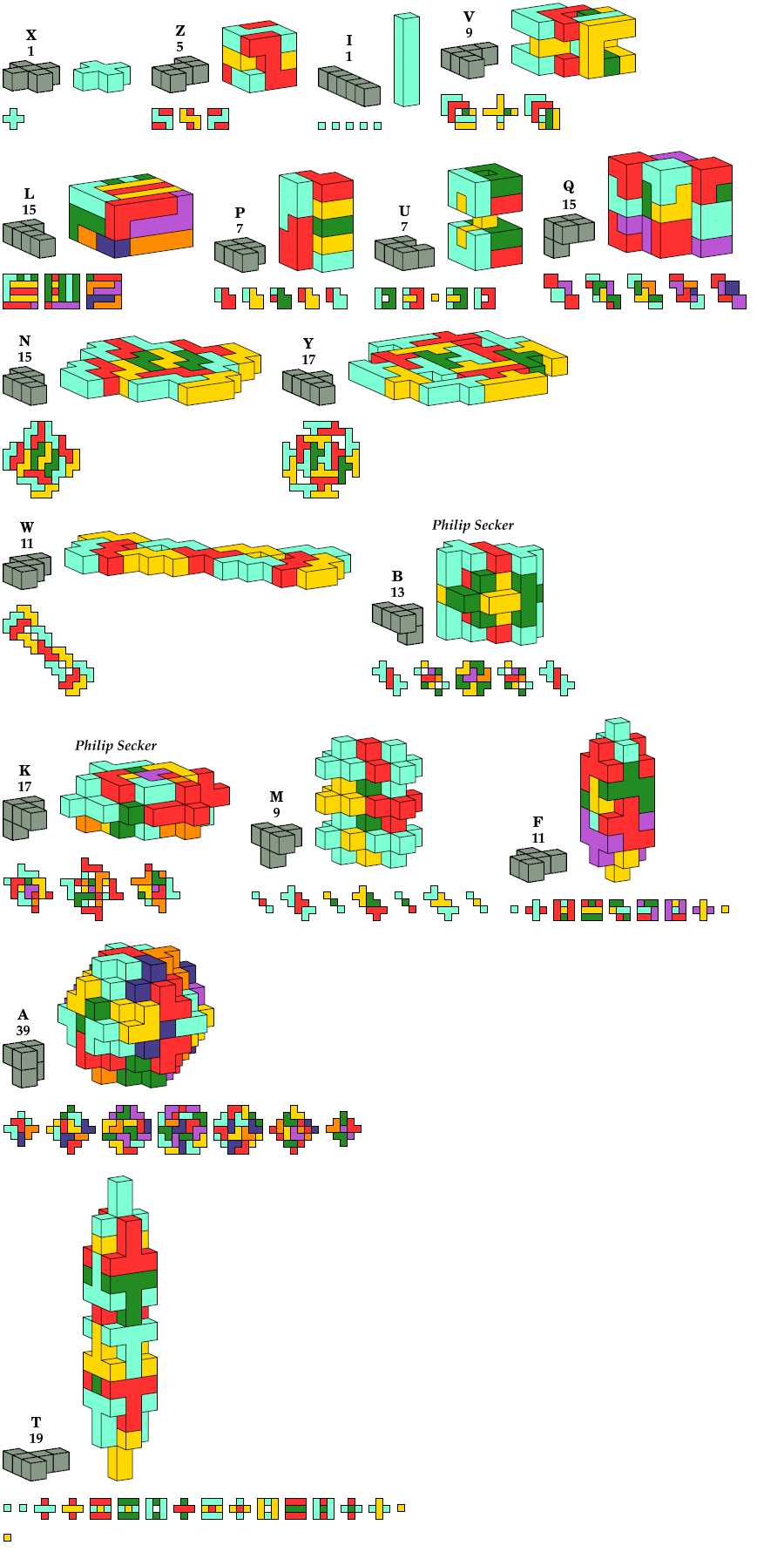
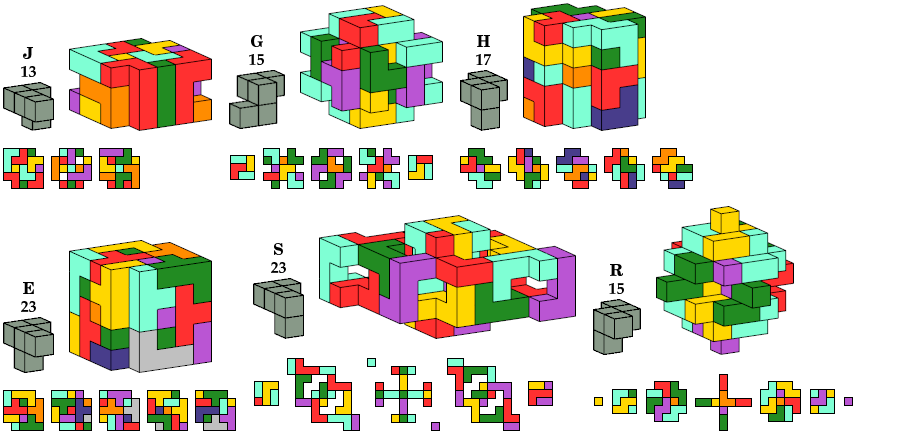
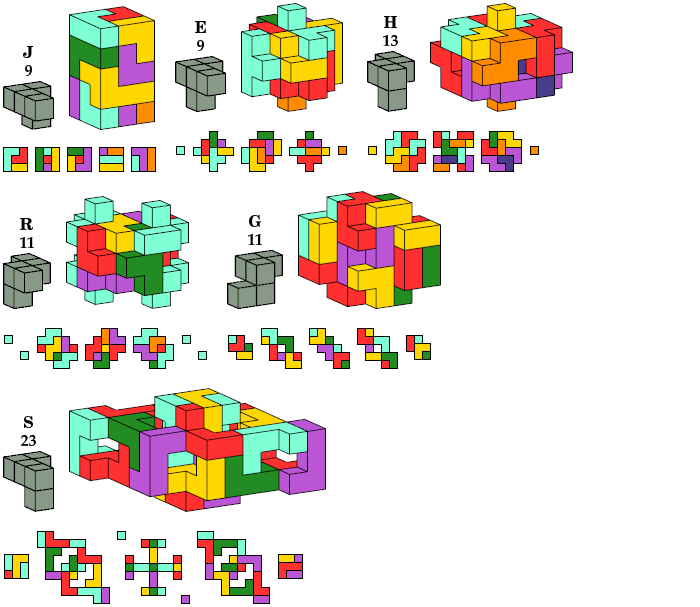
Polycubes have 33 symmetry classes (including asymmetry), and 31 of them have even order. Here I show oddities with mirror symmetry through two diagonal planes and across the axis of their intersection. In all pictures, the cross-sections are shown from top to bottom. If you find a smaller solution, please write.
For other classes of symmetry, see Polycube Oddities.
The smallest example of a polycube with dual diagonal box symmetry and no stronger symmetry is this heptacube (7-cube), as found by W. F. Lunnon:

The solution for pentacube A has full symmetry. No smaller solution is known.
The solutions for pentacubes N, W, X, and Y are polycube equivalents of the smallest known dual diagonal oddities for the corresponding pentominoes. No smaller solutions are known.
Last revised 2026-10-29.