Polyform Curiosities

S. W. Golomb coined the term polyomino for a figure formed by adjoining squares edge to edge. The term is an etymologically unsound generalization of domino.

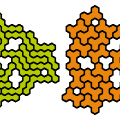
Similarly, a polyiamond is a figure formed by adjoining equilateral triangles edge to edge. The term is T. H. O'Beirne's etymologically unsound generalization of diamond. A polyhex is a figure formed by adjoining regular hexagons edge to edge. More generally, a polyform is a figure formed by adjoining congruent cells.

Here I present some pages about polyforms.

Exclusion

“No room! No room!” they cried out when they saw Alice coming.

—Lewis Carroll, Alice's Adventures in Wonderland

The exclusion problem is to remove as few cells from the plane as possible so as to exclude a given polyform.

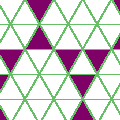
Polyiamond Exclusion. A study of the exclusion problem for polyiamonds.
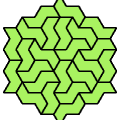
Polyhex Exclusion. A study of the exclusion problem for polyhexes.

Compatibility

A maddening identity of the big picture is arrived at without using any similar pieces.

—Arpad Arutinov, The Back Door of History

Ordinary Compatibility

The Compatibility Problem is to construct a figure that can be tiled with each of a set of polyforms.

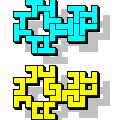
Zucca's Challenge Problem. Given two sets of polyforms, construct a figure that can be tiled with any member of the first set and no member of the second.
Hexiamond Compatibility. Given two hexiamonds, construct a figure that can be tiled with either.
Heptiamond Compatibility. Given two heptiamonds, construct a figure that can be tiled with either.
Mixed Polyiamond Compatibility. Given two polyiamonds of different orders, construct a figure that can be tiled with either.
Pentahex Compatibility. Given two pentahexes, construct a figure that can be tiled with either.
Five Euphoric Pentahexes. Each of these pentahexes is compatible with all 82 hexahexes.
Triple Pentominoes Update. New and improved solutions for Livio Zucca's Triple Pentominoes.
Tetrominoes Challenge Update. Two better solutions for Livio Zucca's Tetrominoes Challenge.

Galvagni Compatibility

Galvagni's problem is to construct a figure that can be tiled with a polyform in more than one way.

Galvagni Figures and Reid Figures for Pentominoes. These figures can be tiled with a pentomino in two or more ways with or without holes.
Galvagni Figures and Reid Figures for Hexominoes. These figures can be tiled with a hexomino in two or more ways with or without holes.
Galvagni Figures and Reid Figures for Heptiamonds. These figures can be tiled with a heptiamond in two or more ways with or without holes.
Galvagni Figures and Reid Figures for Octiamonds. These figures can be tiled with an octiamond in two or more ways with or without holes.
Galvagni Figures & Reid Figures for Pentahexes. These figures can be tiled with a pentahex in two or more ways with or without holes.
Galvagni Figures & Reid Figures for Hexahexes. These figures can be tiled with a hexahex in two or more ways with or without holes.
Galvagni Figures & Reid Figures for Heptahexes. These figures can be tiled with a heptahex in two or more ways with or without holes.
Galvagni Figures & Reid Figures for Octahexes. These figures can be tiled with an octahex in two or more ways with or without holes.
Plover Figures for Polyiamonds and Polyhexes. These figures can be tiled with a polyiamond or a polyhex in two or more ways without flipping it over.

Baiocchi Figures

A Baiocchi figure has full symmetry and is formed by joining copies of a single polyform. Most Baiocchi figures involve Galvagni figures.

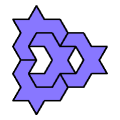
Baiocchi Figures for Polyiamonds. Arrange copies of a single polyiamond to form a figure with full symmetry.
Baiocchi Figures for Polyominoes. Arrange copies of a single polyomino to form a figure with full symmetry.
Baiocchi Figures for Polypents. Arrange copies of a single polypent to form a figure with full symmetry.
Baiocchi Figures for Polyhexes. Arrange copies of a single polyhex to form a figure with full symmetry.
Baiocchi Figures for Polyhepts. Arrange copies of a single polyhept to form a figure with full symmetry.
Baiocchi Figures for Polyocts. Arrange copies of a single polyoct to form a figure with full symmetry.
Baiocchi Figures for Polyenns. Arrange copies of a single polyenn to form a figure with full symmetry.

Cell Shifting

The Cell Shifting Problem is to join copies of a polyform to construct two figures that differ in just one cell.

Cell Shifts for Polyominoes. From copies of the same polyomino of order up to 6, make two figures that differ by just one cell.
Cell Shifts for Heptominoes. From copies of the same heptomino, make two figures that differ by just one cell.
Cell Shifts for Polyiamonds. From copies of the same polyiamond of order up to 7, make two figures that differ by just one cell.
Cell Shifts for Octiamonds. From copies of the same octiamond, make two figures that differ by just one cell.
Cell Shifts for Polyhexes. From copies of the same polyhex, make two figures that differ by just one cell.
Cell Shifts for Hexahexes. From copies of the same hexahex, make two figures that differ by just one cell.
Cell Shifts for Heptahexes. From copies of the same heptahex, make two figures that differ by just one cell.

Oddities

“That is another of your odd notions,” said the Prefect, who had the fashion of calling everything “odd” that was beyond his comprehension, and thus lived amid an absolute legion of “oddities.”

—Poe, “The Purloined Letter”

An oddity is a figure with binary symmetry made by joining an odd number of copies of a polyform.

Polyominoes

Polyomino Oddities. Oddities for polyominoes of order up to 7.
Pentomino Oddities. Pentomino oddities with various symmetries.
Hexomino Oddities. Hexomino oddities with various symmetries.

Polykings

Pentaking Oddities. Oddities with various symmetries for pseudopolyominoes of order 5.

Polyiamonds

Pentiamond, Heptiamond, and Enneiamond Oddities. Oddities for pentiamonds, heptiamonds, and enneiamonds. Oddities for polyiamonds of odd order can have only bilateral symmetry.
Hexiamond Oddities. Hexiamond oddities with various symmetries.
Octiamond Oddities. Octiamond oddities with various symmetries.
Polyiamond Tri-Oddities. These are like oddities but with ternary symmetry.

Polyhexes

Polyhex Oddities. Oddities for polyhexes of order up to 5, with various symmetries.
Hexahex Oddities. Hexahex oddities with various symmetries.
Heptahex Oddities. Heptahex oddities with various symmetries.
Polyhex Tri-Oddities. Tri-oddities for polyhexes of order up to 5.
Hexahex Tri-Oddities. Tri-oddities for hexahexes.
Heptahex Tri-Oddities. Tri-oddities for heptahexes.

Polypents

Pentapent Oddities. Oddities for pentapents.

Catalogues

It was a strange collection, . . . but so much larger and so much more varied that I think I never had more pleasure than in sorting them.

—Robert Louis Stevenson, Treasure Island

Catalogue of Polypents. Enumerations and pictures of these neglected polyforms.

Wallpaper

My wallpaper and I are fighting a duel to the death. One or the other of us has to go.

—Oscar Wilde

Tetromino Wallpaper.
Pentiamond Wallpaper.
Tetrahex Wallpaper.
Dragomino Wallpaper. A Dragomino is the polyomino equivalent of a Dragon Curve.

Polyform Links

Polyiamonds, at Mathematische Basteleien (in German)
Miroslav Vicher's Polyiamonds Page
Andrew Clarke's The Poly Pages
Iamonds at Ed Pegg's mathpuzzle.com
Polyominoes and Other Animals at The Geometry Junkyard
Polyiamond at MathWorld
Livio Zucca's Remembrance of Software Past
The September 2004 issue of Erich Friedman's Math Magic, on polyform compatibility.
The November 2004 issue of Erich Friedman's Math Magic, on Galvagni's Multiple Tiling Problem.
Peter's Polyform Pages.
Michael Reid's Polyomino Page.
Giovanni Resta's Polypolyominoes.
Jorge Luis Mireles's Poly2ominoes.
KSO Glorieux Ronse's Pentomino site, established by Odette De Meulemeester.

Acknowledgment

Many of my constructions were found using the computing resources of Netrics.

Col. G. L. Sicherman [ HOME | MAIL ]