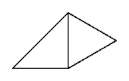
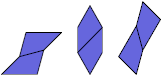
Its interior angles are 45°, 105°, 60°, and 150°.
As far as I know, it first appeared
in Michael Goldberg's article Central Tessellations
in volume 21 of Scripta Mathematica in 1955.
The term aboloiamond (abolo + iamond) is due to Masayoshi Iwai.
He designed a puzzle called
Aboloiamond 48,
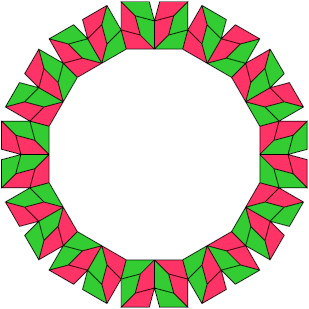
consisting of 48 aboloiamonds in a dodecagonal tray.
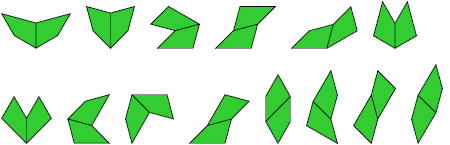
A diaboloiamond is a polyform formed by joining two aboloiamonds at equal edges. There are 14 diaboloiamonds, identifying mirror images:
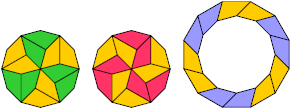
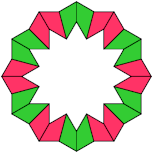
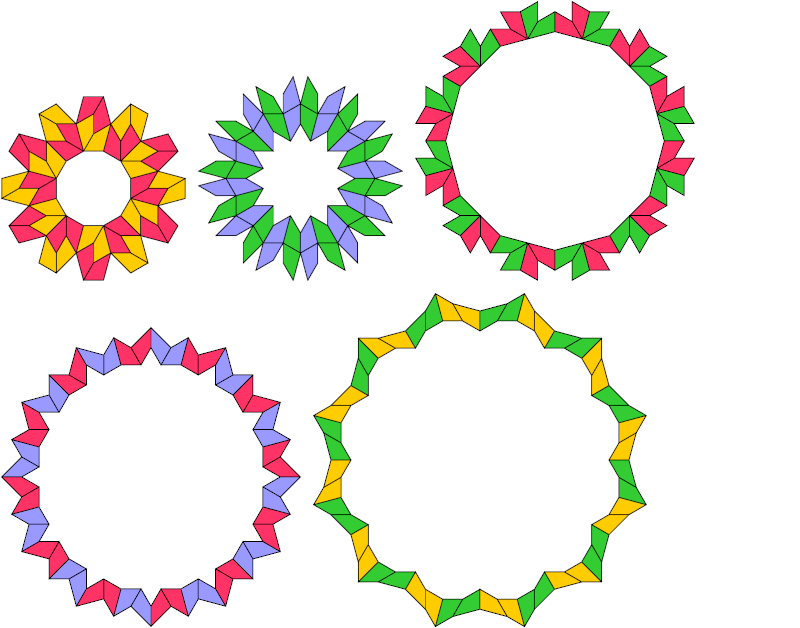
A Baiocchi Figure for a polyform P is a polyform made by joining copies of P and having the maximum symmetry for that class of polyforms. For polyaboloiamonds this is 12-fold rotary symmetry with reflection.
Here I show a minimal known Baiocchi Figure, if any, for each diaboloiamond.
I am grateful to Irmtraud Beyer for telling me about the history of aboloiamonds.

Last revised 2025-10-15.