
In 1996, Torsten Sillke reported having found a point-symmetric arrangement of 17 F pentacubes. He asked whether 17 is the least such odd number, and more generally whether an odd number of copies of a polycube can be arranged to achieve any given symmetry. This was the earliest known mention of polyform oddities.
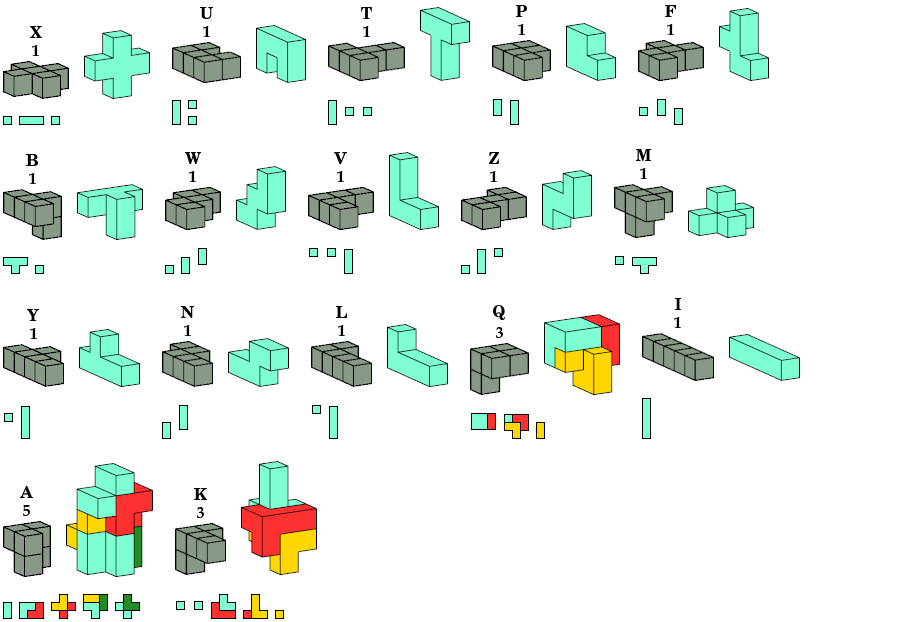
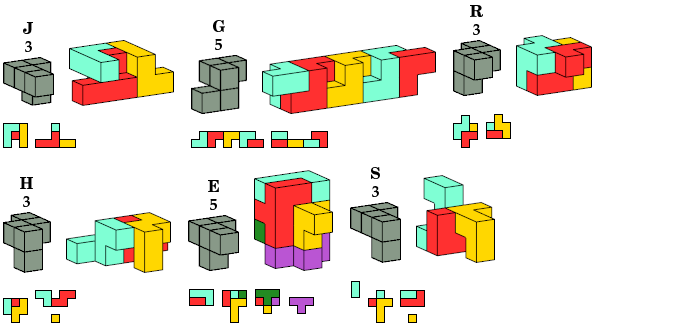
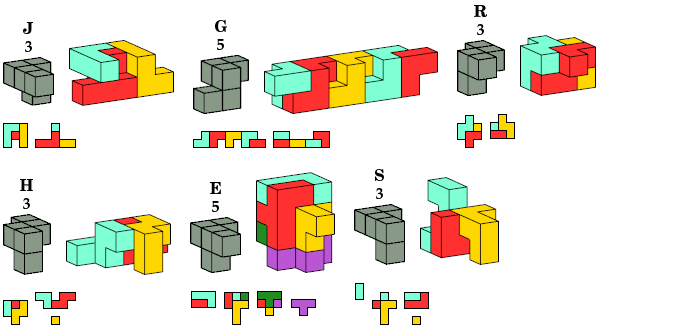
Polycubes have 33 symmetry classes (including asymmetry), and 31 of them have even order. That is too many to show here. Instead I show only oddities with orthogonal mirror symmetry. In all pictures, the cross-sections are shown from top to bottom. If you find a smaller solution, please write.
For other classes of symmetry, see Polycube Oddities.
The smallest example of a polycube with orthogonal mirror symmetry and no stronger symmetry is the L tetracube, as found by W. F. Lunnon:
Last revised 2023-02-19.