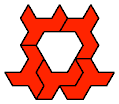
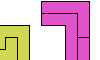
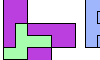
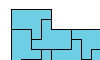
 | Tiling an L Shape with a Polyomino.
Tile an L-shaped polyomino with copies of a given polyomino. |
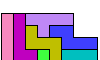 | Tiling an L Shape
with the 12 Pentominoes.
Tile various L-shaped polyominoes with the 12 pentominoes. |
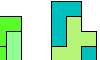 | Tiling an L Shape with a Tetromino
and a Pentomino.
Tile an L-shaped polyomino with copies of a given tetromino and pentomino. |
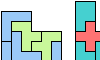 | L Shapes From
Two Pentominoes.
Form an L-shaped (hexagonal) polyomino
with copies of two pentominoes, using at least one of each. |
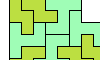 | Tiling an L Shape
with a Tetromino and a Hexomino.
Form an L-shaped (hexagonal) polyomino
with copies of a tetromino and a hexomino, using at least one of each. |
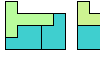 | Tiling an L Shape
with a Pentomino and a Hexomino.
Form an L-shaped (hexagonal) polyomino
with copies of a pentomino and a hexomino, using at least one of each. |
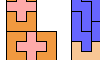 | Isolated Pentomino Pair
L-Shapes.
Form an L-shaped (hexagonal) polyomino
with copies of two pentominoes, using at least one of each,
and isolating the copies of one. |
 | Holey L Shapes From
Two Pentominoes.
Form an L-shaped (hexagonal) polyomino
with copies of two pentominoes, using at least one of each,
and allowing one-celled holes that do not touch the perimeter
or one another. |
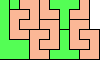 | Scaled Two-Pentomino
L Shapes.
Form an L-shaped (hexagonal) polyomino
with copies of two pentominoes, letting them be enlarged,
using at least one of each. |
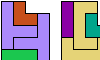 | Tiling an L Shape
with a Hexomino and Isolated Trominoes.
Form an L-shaped (hexagonal) polyomino
with copies of a hexomino and at least one tromino,
not letting the trominoes touch at edges or corners.
|
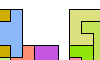 | Tiling a Hexomino at
Scales 1, 3,3 ,4.
Scale up some hexomino at factors 1, 3, 3, 4
and tile these shapes with the 35 hexominoes. |
 | L Shapes From
Two Hexominoes.
Form an L-shaped (hexagonal) polyomino
with copies of two hexominoes, using at least one of each. |
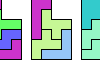 | Tiling an L Shape with
Three Pentominoes.
Tile an L-shaped polyomino with copies of three given pentominoes. |
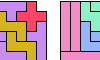 | Scaled Three-Pentomino
L Shapes.
Tile an L-shaped polyomino with copies of three given pentominoes
at various sizes. |
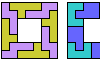
| Two-Pentomino Square Frames. |
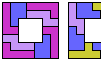
| Three-Pentomino Square Frames. |
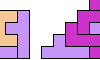
| Tiling Right
Trapezoidal Polyominoes with Two Pentominoes. |
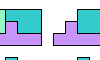
| Tiling Right
Trapezoidal Polyominoes with Three Pentominoes. |
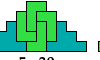
| Tiling a Blunt Pyramid
with Two Polyominoes. |

| Full Symmetry from the Twelve
Pentominoes. |
| Tiling a Hexomino at
Scales 1, 3, 3, 4.
Scale up some hexomino at factors 1, 3, 3, 4
and tile these shapes with the 35 hexominoes. |
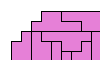
| Tiling a Beveled Rectangle with
Polyominoes. |
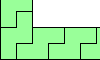 | Tiling Strips with
Polyominoes.
Tiling straight, bent, branched,
and crossed infinite strips with polyominoes of orders 1 through 6. |
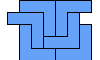 | Uniform Polyomino
Stacks.
Join copies of a polyomino to make a figure with uniform row width. |
 | Globular 3-4-5
Pentomino Dissections.
Dissect a pentomino at scale 5 into two copies of the pentomino at scales
3 and 4, with the pentomino at scale 4 unbroken.
|
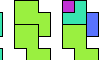 | Perfect Polyominoes.
Polyominoes that can be formed by joining all the smaller polyominoes
that can tile them. |
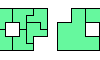 | Polyomino Bireptiles.
Join two copies of a polyomino, then dissect the
result into equal smaller copies of it. |
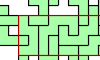 | Covering a Rectangle
with Copies of a Polyomino.
Find the largest rectangles that copies of a polyomino can cover
without overlapping. |
 | A Pentomino
Christmas Card.
Pentomino art with an unexpected aftermath. |